I walked into the muffler shop today and noticed the sign on the wall.
PRICE LIST
$40 an hour if we do the work.
$60 an hour if you watch us work.
$80 an hour if you help us work.
“Clever”, I mused, “that looks like a blog theme to me.” I then thought of the high cost of missions.
DOERS - Those who do the work are the people who have made a commitment to take on the task of cross-cultural service as a career. I can hardly believe how expensive it is to live in places like Mumbai, Kiev or Santiago. For a family of four a flat will can easily cost $1,000 a month. To do be engaged in the work overseas, along with taxes and insurance, you’re looking at least $50K a year. Financing the doers is not cheap, but still probably the most cost effective.
WATCHERS - Those who observe the work are short-term teams who travel overseas to experience ministry for two weeks or less. Take an average group of ten to fifteen people and the tab will easily be $30K. Glad they came, hope they caught the vision; the money they spent for the experience probably wouldn’t be given to missions anyway. Who knows, the 10 day trip might be a good investment in the long-term, but short-term missions is a program primarily for the watchers, they can’t really contribute much to the real work on the field.
INTRUDERS - Those who want to do the work are congregations who have determined that they want to be stakeholders in overseas ministry, though they don’t want to live on the field, learn a language or send their kids to local schools. By underwriting national programs, schools, orphanages, they will easily invest $100K a year, which includes teams going to the field, buying land and buildings. I know of one fellowship that has “adopted” a people group in Asia and is building a school, though they cannot mention the name of Christ nor even display a cross. Another congregation is involved in “harvest ministries,” which starts churches in Africa and Philippines by pouring thousands of dollars to reach those nations who already have a huge Christian population. Believing they can do better or maybe just a well, they by-pass the on-field doers.
Like the muffler shop, anyone of the three option’s one chooses will get the job done. It’s a matter of how much do you want to pay for the process to get the best results.
Friday, July 07, 2006


Tuesday, July 04, 2006
One Nation Under God
 In 1976, when our country celebrated its 200th birthday, I was living in Africa and people we’re talking about America’s “image” before the rest of the world. We were a couple of years out of the unpopular Viet Nam war, one year after Watergate and the resignation of President Richard Nixon. This morning as I woke to our nations 230th founding as a nation I again listened to those discussing America’s image in other parts of the world.
I am not one of those card-carrying conservatives that believe that the hope of the world rests in the hands of our country. Economically, if we falter the domino effect will indeed have repercussions globally. We are not a particularly moral country and we seem to be less so with each passing year. Our government policies have gaping holes in them and I, quite honestly, wish our leaders, both Democrat and Republicans, would make decisions based on what is right versus what they think is more popular in getting them elected to office or gaining favor with world opinion. But in spite of the obvious deficiencies with my country I am not apologetic of who we are as nation.
What many people in other countries do not understand about America is our values, as they don’t share those values. All nations are built on principles, some being religious such as Islam, Hindu or Buddhist. Some countries hold the ideology of “the common good,” with policies that lean toward social programs and state run assistance. Many countries are driven by nationalism, which tend to splinter the population by ethnicity or tribe. When values are in conflict, so, too, will their disagreement on how things should be.
The value of a majority of American’s is one of freedom and independence, primarily religious freedom. Our rebellion from the rule of King George of England over 200 years ago still remains the same, i.e., we want less government interference in our lives and the common good is through what we believe is best for collective individualism. Government is only good as it is seen to benefit us, individually as well as collective. If our government officials don’t reflect our wishes we vote them out of office.
If we have disagreement with our own, it shouldn’t surprise anyone that most Americans are not be driven by what others, outside of our country, think on how we should behave. While we do want to be liked and respected by others, our values are as unique as our country itself. We understand our responsibility as the only superpower; we understand that our values do affect the nations of the world. Governments, represented in the U.N., have never appreciated our values and are frustrated that we don’t conform to what they think is best for the rest of the world.
What is always interesting to me is that; while the most popular thing to do is bash America, most countries privately seek our aid, trade and even our form of government. In essence, they want the best of what we are but reserve the right to hold their own values. As best we can accommodate those conflicting issues we try. But in the end of the day, Americans will always hold onto their values in spite of those who disagree with us.
God is not a politician. His values are neither American nor that of any other nation. America’s success or failure is dependent on America’s willingness to submit to His will and His values. If America becomes more concerned by the will of others over its desire to seek His agenda for all mankind it will go down in history as other nations who have turned their back on God. I’m a follower of Christ first, an American second. Make no mistake; I am a proud to be an American. America is a country where freedom of religion is a value, and because of that value I had the opportunity to hear the Gospel. Through my own free will, without fear of oppression or persecution from family or state, America gave me the opportunity to become a follower of Christ. It is for that reason I join my country today to celebrate 230 years as a nation.
Friday, June 30, 2006
Never No More
“They are no more.”
That is the way Hindu’s refer to the death of their family or friends. It’s an interesting expression, which says a great deal about their worldview. In contrast, in the West we refer to the death of someone by saying they have “passed away.”
Most Hindu’s believe in reincarnation, a 12,000 recycling of the soul into other forms of life until one reaches moksha (freedom from cyclical life). When someone dies they are no more from their present state; they are also no more from their identity as a person. My 80-year-old friend, Mr. Kumar, ceases not only to live, but also to be Mr. Kumar. He really wasn’t Mr. Kumar when I knew him; it was just his present state. Mr. Kumar is no more; he is now someone or something else. While this teaching may seem odd to those outside the faith, Hindu’s find comfort that life continues even if the state of that person does not.
Those in the West, who do not believe in reincarnation, and especially those of the Christian tradition, view death as the continuation of the personality, passing from life on this earth into an eternal condition. Where that eternal state may be is often a subject of debate. For evangelical Christians we point to the Holy Scriptures, the book of Hebrews which states, “It is appointed ONCE to die, and after that the judgment” (9:27). (Judgment does not refer to punishment but accountability).
Working with the Turkana of Kenya, most of the people were animists. They did not have a concept of an on-going living soul and therefore believed that the death of person meant they were no more. Unlike the Hindu, however, the soul does not move into another cycle of life, but really are no more. The worldview of the nomads in the desert and that of the educated atheist in the halls of academia, at least on this issue, are the same.
As I write this post, my mother-in-law is near death (which literally means separation). When she is separated from this life, her family and friends, she will pass to an eternal state. She, like all of us, has been created unique in person, uniquely an eternal personality. Our Eternal Creator, which does not change in either form or function, remains consistent with His creation. For those who are followers of Christ, we move from separation of life on earth, but we are never no more.
That is the way Hindu’s refer to the death of their family or friends. It’s an interesting expression, which says a great deal about their worldview. In contrast, in the West we refer to the death of someone by saying they have “passed away.”
Most Hindu’s believe in reincarnation, a 12,000 recycling of the soul into other forms of life until one reaches moksha (freedom from cyclical life). When someone dies they are no more from their present state; they are also no more from their identity as a person. My 80-year-old friend, Mr. Kumar, ceases not only to live, but also to be Mr. Kumar. He really wasn’t Mr. Kumar when I knew him; it was just his present state. Mr. Kumar is no more; he is now someone or something else. While this teaching may seem odd to those outside the faith, Hindu’s find comfort that life continues even if the state of that person does not.
Those in the West, who do not believe in reincarnation, and especially those of the Christian tradition, view death as the continuation of the personality, passing from life on this earth into an eternal condition. Where that eternal state may be is often a subject of debate. For evangelical Christians we point to the Holy Scriptures, the book of Hebrews which states, “It is appointed ONCE to die, and after that the judgment” (9:27). (Judgment does not refer to punishment but accountability).
Working with the Turkana of Kenya, most of the people were animists. They did not have a concept of an on-going living soul and therefore believed that the death of person meant they were no more. Unlike the Hindu, however, the soul does not move into another cycle of life, but really are no more. The worldview of the nomads in the desert and that of the educated atheist in the halls of academia, at least on this issue, are the same.
As I write this post, my mother-in-law is near death (which literally means separation). When she is separated from this life, her family and friends, she will pass to an eternal state. She, like all of us, has been created unique in person, uniquely an eternal personality. Our Eternal Creator, which does not change in either form or function, remains consistent with His creation. For those who are followers of Christ, we move from separation of life on earth, but we are never no more.
Tuesday, June 27, 2006
In The Area?
I never call a business meeting unless there is business to discuss.
I never run through an airport to catch a flight.
I never make eye contact with women when traveling through Asia, even if I am talking to them.
I almost never say “grace” over my food unless the person with me insists.
I never read the manual prior to plugging in a new computer program.
and…I AM SELDOM IN THE AREA.
I announced last spring that I would be in the states for the summer. The months of May through July it is too hot in the country we live and my teaching assignments are not in that period, so it’s a good time to return home and visit friends, sponsors and family. At least three donors have written, “If you’re in the area, please come by and see us.”
Perhaps we need definition – what does it mean to be in the area? Between the price of gas and driving time, my area is about 350 miles. Living in northwest Arkansas when we are home, my area then is Arkansas, Oklahoma, north Texas, Kansas and Missouri. Anything beyond that and we are looking at it being cheaper and more time efficient for me to fly.
It was 1975 when I first went out to raise support for our work. Back then gas was $0.58 a gallon (about $1.69 adjusting for inflation in today’s economy) and so driving 300 miles for a $50 dollar honorarium and $35 dollar monthly support wasn’t a bad deal. I wish I could have stayed in a 500-mile radius of home, but that was impossible, so our partners are spread from California to Connecticut. I’m only in another area if someone invites me.
I try to communicate to our partners via email monthly, sometimes more. But I know a personal visit is important. I suppose next year I should plan on being in other areas, but I can already hear it now...“June is not a good month for us, will you be in the area in July?”
I never run through an airport to catch a flight.
I never make eye contact with women when traveling through Asia, even if I am talking to them.
I almost never say “grace” over my food unless the person with me insists.
I never read the manual prior to plugging in a new computer program.
and…I AM SELDOM IN THE AREA.
I announced last spring that I would be in the states for the summer. The months of May through July it is too hot in the country we live and my teaching assignments are not in that period, so it’s a good time to return home and visit friends, sponsors and family. At least three donors have written, “If you’re in the area, please come by and see us.”
Perhaps we need definition – what does it mean to be in the area? Between the price of gas and driving time, my area is about 350 miles. Living in northwest Arkansas when we are home, my area then is Arkansas, Oklahoma, north Texas, Kansas and Missouri. Anything beyond that and we are looking at it being cheaper and more time efficient for me to fly.
It was 1975 when I first went out to raise support for our work. Back then gas was $0.58 a gallon (about $1.69 adjusting for inflation in today’s economy) and so driving 300 miles for a $50 dollar honorarium and $35 dollar monthly support wasn’t a bad deal. I wish I could have stayed in a 500-mile radius of home, but that was impossible, so our partners are spread from California to Connecticut. I’m only in another area if someone invites me.
I try to communicate to our partners via email monthly, sometimes more. But I know a personal visit is important. I suppose next year I should plan on being in other areas, but I can already hear it now...“June is not a good month for us, will you be in the area in July?”
Monday, June 26, 2006

Thursday, June 22, 2006
Struggling With Discontentment
I always enjoy being in my home country, but inevitably I feel unsettled and unhappy with my life. Recently I was with a couple of guys who were telling me about their homes, their vacations and their investments. There is nothing wrong with any of this, but then I begin comparing what I have, or more to the point, what I don’t have, to others. If I wasn’t a nomad, bouncing all over God’s planet, and would settle down in the US, perhaps I would be content. Then again…naw, I probably wouldn’t. But discontent in not being content drives me to write this blog.
The Scriptures (1 Timothy 6:6) tell us that having godly contentment is great gain. Random thoughts on contentment:
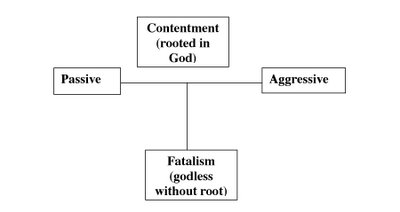
• Contentment is not something to achieve…it’s a process. The prayer of the frustrated, “Lord give me patience and give it to me NOW,” doesn’t work. Contentment and patience often work hand-in-hand.
• If one cannot be content in their present state they probably will never be content. Ask anyone who sought fame and found it, or fortune and became rich, most of the time they die lonely. Contentment is a state of mind, not a goal to achieve.
• Our culture is rooted in discontent (capitalism exports discontent). A thousand voices yell at me each day saying, “If you just had this, you’d be happy.” The genius of capitalism is that it markets a necessity that you really don’t need. It’s called an illusion.
• Interestingly, Hindu’s (dharma) and Muslims Inshaallah (the will of God) are a form of contentment based on fatalism. They are not happier, they are just resigned.
• Unchecked ambition pulls one off balance from being centered in contentment. Nothing wrong with ambition until one strives for the prize, which in the end, will never satisfy.
• On the other end of the spectrum is the idleness disguised as being passively content. You’re not content, you’re just lazy squandering God given ability.
Paul also says (6:8), having food and clothing we should be content. I may not have the best food or clothing, but I sure have it better than many of the people I work with every day outside the US. Wisdom plans for the future, but does not strive to attain that which will always be out of reach. If we work to seek first the things of God, the other things will take care of itself.
The Scriptures (1 Timothy 6:6) tell us that having godly contentment is great gain. Random thoughts on contentment:
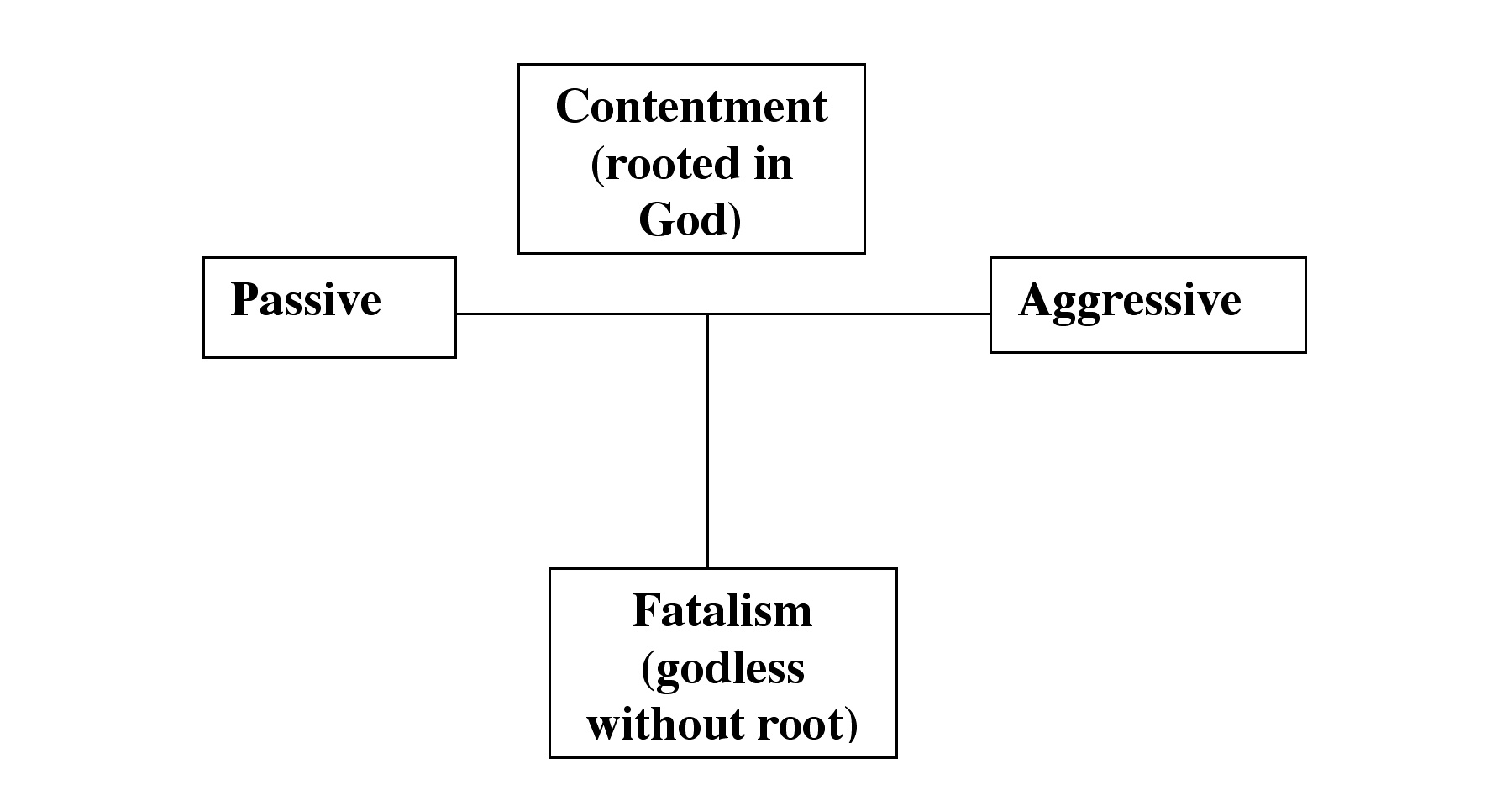
• Contentment is not something to achieve…it’s a process. The prayer of the frustrated, “Lord give me patience and give it to me NOW,” doesn’t work. Contentment and patience often work hand-in-hand.
• If one cannot be content in their present state they probably will never be content. Ask anyone who sought fame and found it, or fortune and became rich, most of the time they die lonely. Contentment is a state of mind, not a goal to achieve.
• Our culture is rooted in discontent (capitalism exports discontent). A thousand voices yell at me each day saying, “If you just had this, you’d be happy.” The genius of capitalism is that it markets a necessity that you really don’t need. It’s called an illusion.
• Interestingly, Hindu’s (dharma) and Muslims Inshaallah (the will of God) are a form of contentment based on fatalism. They are not happier, they are just resigned.
• Unchecked ambition pulls one off balance from being centered in contentment. Nothing wrong with ambition until one strives for the prize, which in the end, will never satisfy.
• On the other end of the spectrum is the idleness disguised as being passively content. You’re not content, you’re just lazy squandering God given ability.
Paul also says (6:8), having food and clothing we should be content. I may not have the best food or clothing, but I sure have it better than many of the people I work with every day outside the US. Wisdom plans for the future, but does not strive to attain that which will always be out of reach. If we work to seek first the things of God, the other things will take care of itself.
Monday, June 19, 2006
What Is Missions?
There is a lot of confusion in the American church when it comes to missions. First of all, what is missions? Which project listed below would your church fund out of the mission budget?
a. Vacation Bible School
b. Radio or television ministry
c. Youth camp
d. Christian crisis pregnancy clinics
e. Promise Keepers event
f. Starting a new church in the neighboring town or state
g. Funding mission or global outreach conference
If your view of missions leans more towards cross-cultural work, what projects does your church support (probably a combination with the list below, so what are the percentages)?
1. Church planting only
2. Church planting primarily in unreached countries
3. Social programs (orphanages, food programs or medical projects)
4. Training programs (schools, training material, trainers)
5. Literature (Bibles, tracts)
6. American personnel
7. National pastors or evangelists
What is your definition of missions? Last week I heard of a young couple that presented their ministry for Senegal. The mission committee responded by saying, “We would love to support you, but our short-term mission trips have depleted our budget.” Recently a “mission team” from Louisianaiana traveled to northwest Arkansas to conduct Back Yard Bible Clubs. Just what is missions?
a. Vacation Bible School
b. Radio or television ministry
c. Youth camp
d. Christian crisis pregnancy clinics
e. Promise Keepers event
f. Starting a new church in the neighboring town or state
g. Funding mission or global outreach conference
If your view of missions leans more towards cross-cultural work, what projects does your church support (probably a combination with the list below, so what are the percentages)?
1. Church planting only
2. Church planting primarily in unreached countries
3. Social programs (orphanages, food programs or medical projects)
4. Training programs (schools, training material, trainers)
5. Literature (Bibles, tracts)
6. American personnel
7. National pastors or evangelists
What is your definition of missions? Last week I heard of a young couple that presented their ministry for Senegal. The mission committee responded by saying, “We would love to support you, but our short-term mission trips have depleted our budget.” Recently a “mission team” from Louisianaiana traveled to northwest Arkansas to conduct Back Yard Bible Clubs. Just what is missions?
Thursday, June 15, 2006
Training In Ukraine
 I met Sergey in Ukraine at a pastors conference hosted by Church Leadership Development International (CLDI.org). He attended my workshop on “Being a Bridge for God.” Sergey had a lot of questions, as everything I taught was new to him. English is not his first language, but I was delighted to receive this note from him.
"I want to tell you, that after that week that I had a possibility to attend your lectures I refilled my spiritual strength, and started to work even willingly at the God’s field. When I came back home from that conference I talked to my wife and we come to decision that my family will follow the Lord, and since that time our home belongs to God and we will serve him.
Please pray for a chance to start a service among Gypsies. If everything will be alright I am planning to start this in September. I wish I could visit you and learn more about correct missionary work. I am grateful to you once again that you devote your time for me."
Sergey, like most pastors in the former Soviet Union, serve bi-vocationally. I have great admiration for guys like Sergey and so many other faithful servants who work hard each day to put physical bread on their table but also work diligently to give the Bread of Life to those in their community. CLDI provides a great opportunity for pastors to get training. I am grateful for the opportunity I had to be a part of this year’s conference and to get an chance to encourage and help people, like Sergey, in their ministry.
Sunday, June 11, 2006
Role Model In Dying
Malcom is a guy who works in Taiwan. I’m not sure if I’ve personally met Malcom, but we have interacted several times over email. I think we probably don’t see eye-to-eye on some missiological issues, but we have more in common than disagreements.
Malcom is dying. He has cancer and, according to a recent post by his wife, probably doesn’t have long to live. Malcom sent a post today to his friends saying that he is too weak to continue much dialogue and gave a farewell to those who know him.
I’m writing these thoughts about Malcom because he is a bit of a role model to me on how to die. Even though his fate is sealed with an incurable disease, he hasn’t made a big deal about it. Instead of dwelling on the inevitable, he has been trying to carry on with life as usual. I know he is concerned about his families welfare after he’s gone, but the tone of the way he is winding up his days on this earth seems to be one of quite resolve and bit matter-of-fact. That’s what I admire about Malcom’s dying.
I contrast Malcom’s situation with others I have known which have faced the expected. Their letters, unlike Malcom’s, is a weekly medical update and prayer for deliverance, that God will miraculously intervene. Malcom has also asked that people pray for him, but more for grace as he nears his end as well as for those who he will leave behind.
I have no idea how I would react if I was told I had cancer and may or may not live for another year. But as a Christian, who claims that my hope is in Christ and to be absent from the body is to be present with the Lord, I should see death as a spectacular transition to the fulfillment of my purpose of existence. I would like to think I would seek all the medical help possible, as I don’t think we are to foolishly hasten our own demise. But when it becomes crystal clear that my days are few, I hope that, as much as my ailing body will allow, I will carry on with life as usual until I can’t wake up.
Thanks, Malcom, for a great example on how to die. We will see you soon.
Malcom is dying. He has cancer and, according to a recent post by his wife, probably doesn’t have long to live. Malcom sent a post today to his friends saying that he is too weak to continue much dialogue and gave a farewell to those who know him.
I’m writing these thoughts about Malcom because he is a bit of a role model to me on how to die. Even though his fate is sealed with an incurable disease, he hasn’t made a big deal about it. Instead of dwelling on the inevitable, he has been trying to carry on with life as usual. I know he is concerned about his families welfare after he’s gone, but the tone of the way he is winding up his days on this earth seems to be one of quite resolve and bit matter-of-fact. That’s what I admire about Malcom’s dying.
I contrast Malcom’s situation with others I have known which have faced the expected. Their letters, unlike Malcom’s, is a weekly medical update and prayer for deliverance, that God will miraculously intervene. Malcom has also asked that people pray for him, but more for grace as he nears his end as well as for those who he will leave behind.
I have no idea how I would react if I was told I had cancer and may or may not live for another year. But as a Christian, who claims that my hope is in Christ and to be absent from the body is to be present with the Lord, I should see death as a spectacular transition to the fulfillment of my purpose of existence. I would like to think I would seek all the medical help possible, as I don’t think we are to foolishly hasten our own demise. But when it becomes crystal clear that my days are few, I hope that, as much as my ailing body will allow, I will carry on with life as usual until I can’t wake up.
Thanks, Malcom, for a great example on how to die. We will see you soon.
Thursday, June 08, 2006
So You Think Your Church Is Missional?

My wife, Sandy, has a theory about churches and their understanding of world missions. If in the Q and A they ask questions beyond, "What do the natives eat?" they are probably above average.
I thought about that theory when I received this cartoon from a friend of mine.
Monday, June 05, 2006
I'm Back
After one week in Colorado and this past week in Ukraine, I am back to the world of blogosphere. Things I learned while away from my computer:
1. I still can’t fish. I like the concept of catching trout with a fly (seems more organic), and it’s more fun slinging the fly-line back and forth…but I still don’t catch fish.
2. I’m not in as good physical shape as I thought. The mountain I climbed at Crested Butte three years ago I gave up on before reaching the top this year. The route we took was steeper than before, but the reality is my legs gave up on me.
3. I hate to drive. The reason God created airplanes was for trips over six hours. Even with my son-in-law sharing the driving load, 16 hours in a van is not an enjoyable experience.
4. Even though they are grown and we lived in the same house for a week, I still love my kids and grandkids.
5. People who share their wealth are a rare treasure. The people who provided the lodge we stayed in built it specifically to give people who live overseas a place of retreat.
6. Russian food is still my least favorite. Hot dogs and potatoes for lunch or supper is not a hardy meal.
7. I hate flying in the summer. Way too many tourists.
8. Charles de Gaulle is the most inefficient airport in Europe. If you have an hour or less to catch your connecting flight, forget about it.
9. Good cheeseburgers can be had at TGI Friday’s in Kiev.
10. The world keeps on moving, whether I have Internet access or not.
1. I still can’t fish. I like the concept of catching trout with a fly (seems more organic), and it’s more fun slinging the fly-line back and forth…but I still don’t catch fish.
2. I’m not in as good physical shape as I thought. The mountain I climbed at Crested Butte three years ago I gave up on before reaching the top this year. The route we took was steeper than before, but the reality is my legs gave up on me.
3. I hate to drive. The reason God created airplanes was for trips over six hours. Even with my son-in-law sharing the driving load, 16 hours in a van is not an enjoyable experience.
4. Even though they are grown and we lived in the same house for a week, I still love my kids and grandkids.
5. People who share their wealth are a rare treasure. The people who provided the lodge we stayed in built it specifically to give people who live overseas a place of retreat.
6. Russian food is still my least favorite. Hot dogs and potatoes for lunch or supper is not a hardy meal.
7. I hate flying in the summer. Way too many tourists.
8. Charles de Gaulle is the most inefficient airport in Europe. If you have an hour or less to catch your connecting flight, forget about it.
9. Good cheeseburgers can be had at TGI Friday’s in Kiev.
10. The world keeps on moving, whether I have Internet access or not.
Friday, May 19, 2006
Gone Fishin
In a couple of hours we travel to the backside of God's Rockies for a week of vacation. Along with our kids and grankids, I don't plan to post anything. Actually, I'm not sure, where we will be, that I will even have access to email. I do my most of my writing, not at the keyboard, but while I am driving or walking. I suspect that as I try my hand at fly fishing I will have plenty of time to write several blogs. I might even write another book.
From Colorado I travel to Ukraine. Somewhere in-between I will touch base.
From Colorado I travel to Ukraine. Somewhere in-between I will touch base.
Thursday, May 18, 2006
Be Slow To Speak
We all know that words can be emotionally and intellectually compelling. A phrase, a sentence, an intentional pause meant to capture the attention of the audience before unloading a specific point, represents the power of verbal communication. This past week, listening to testimonies of newly appointed missionaries, two stand out.
“I fell in love with Panama…after the eighth day,” said one young woman recounting her two-week fact finding trip to Central America. The weather was hot and humid when she first arrived, but she obviously adjusted and in the remaining six days, allowing her to fall in love with the country she and her husband were called to serve. After six months on the field, with the humidity a constant reality, the foreign language that will be the enemy before it becomes a friend, the realization that going home is more than a week away, time will tell if they will still be in love with their adopted country of service.
“I hated Mexico,” another woman confessed. “I hated it so much that I actually prayed that God would do something to remove me from the field. I even prayed, I embarrassed to admit, that God would give me cancer so I could come off the field.” That was over ten years ago, and now this lady, who really does love the field she has worked in, is battling ovarian cancer. She and her husband will return to Mexico City in a few weeks, to spend as much time there before her health deteriorates to the place that she must come home.
We all say things that years later we wish we would we could retract. I guess that is why the scriptures reminds us "to be slow to speak."
“I fell in love with Panama…after the eighth day,” said one young woman recounting her two-week fact finding trip to Central America. The weather was hot and humid when she first arrived, but she obviously adjusted and in the remaining six days, allowing her to fall in love with the country she and her husband were called to serve. After six months on the field, with the humidity a constant reality, the foreign language that will be the enemy before it becomes a friend, the realization that going home is more than a week away, time will tell if they will still be in love with their adopted country of service.
“I hated Mexico,” another woman confessed. “I hated it so much that I actually prayed that God would do something to remove me from the field. I even prayed, I embarrassed to admit, that God would give me cancer so I could come off the field.” That was over ten years ago, and now this lady, who really does love the field she has worked in, is battling ovarian cancer. She and her husband will return to Mexico City in a few weeks, to spend as much time there before her health deteriorates to the place that she must come home.
We all say things that years later we wish we would we could retract. I guess that is why the scriptures reminds us "to be slow to speak."
Sunday, May 14, 2006
Book Release
 For years people have been asking me to write a book. I’ve joked that if I did it would be entitled, “A Case Study On How NOT To Do Missions,” or “The Top 1000 Mistakes I’ve Made in Ministry.” I’ve compromised and have written a book that is a mission guide called, The Journey of a Post-Modern Missionary: finding one’s niche in cross-cultural ministry.
The Journey Of A Post-Modern Missionary
The success of one living overseas is finding job satisfaction. The importance of occupational contentment is true with any person anywhere in the world, but it is particularly true with missionaries. This book demonstrates that finding one's niche is a process. Happy is the person who discovers their niche early in life. The discovery of giftedness, for many of us, however, is usually long and uncertain.
Though this book is autobiographical, at the conclusion of each chapter are journey niche notes, which are practical applications of lessons learned. Niche notes also answer some of the common questions I’ve received from over thirty years in training and coaching missionaries in over twenty countries.
There are three ways you can order this book. (1) A signed copy through our website, (2) Through our publisher, Xulon Press and Amazon.com,(3) Through our office mailing address.
Thursday, May 11, 2006
I See Dead People
How many movies can you identify from a phrase?
“Truth, you want truth? You can’t handle the truth.”
“Look up in the sky! Is it a bird? Is it a plane? No, it’s ….!
“I am the patron saint of mediocrity?
“Frankly, my dear, I don’t give a damn.”
I was reminded of great movie lines from listening to sermon this past week when the pastor said, “I see dead people. I see them all the time.”
Of course that line was from the movie the “Sixth Sense,” the little boy who saw the dead walking around, and who helped Bruce Willis understand that he, indeed, was dead.
The pastor made a wonderful application using that phrase, suggesting that it would be a great to have a t-shirt with the words printed on it, “I see dead people.” It certainly would be a conversation starter. I’m not big on T-shirt evangelism, but that is one that I might embrace, if I was a visiting professor at a secular university.
In reality, we are all dead-men walking. No one knows the time of our demise, but each day we not only live, but we are in the process of dying. Today the cancer (or heart disease, diabetes, etc.) may not yet be detected in my body, but somewhere, sometime, the inevitable will be revealed. Of course, there are other dynamics in this world that may determine my end, like war, accident or maybe the pandemic bird flu. Morbid, I agree, but reality, nevertheless.
If you feel good physically and don’t know you’re sick you’re probably feeling pretty good. We go out to dinner, make plans for weekend fun and even plan toward retirement. Yeah, we know we will die some day, but the doctor has given us a clean bill of health so we’re not thinking about the reality that each second we go further into physical decay, one second closer to eternity.
Beyond than physical, I see the spiritually dead. People, young and old, of every nation are physically able but spiritually dead. Like their physical condition, people may be moral, even religious. They are not murderers, thieves and they even try to help people in their community. Some go to the temple or church everyday to pray, they may even give money to the poor. And yet, with all that seemingly healthy spirituality (the new term today…"I'm not religious, but I am spiritual") they are in reality dead.
“There is a way that seems right to man,” the ancient preacher said, “but his way leads to death.” Most people think that that way they are following, from a religion to good works, will lead them to God, but not all roads lead to heaven. For the followers of Christ we were dead, yet we are alive.
Why do I do what I do, living overseas away from family to teach others how to present the message of Christ and salvation? It’s because I see dead people. I see them all the time.
“Truth, you want truth? You can’t handle the truth.”
“Look up in the sky! Is it a bird? Is it a plane? No, it’s ….!
“I am the patron saint of mediocrity?
“Frankly, my dear, I don’t give a damn.”
I was reminded of great movie lines from listening to sermon this past week when the pastor said, “I see dead people. I see them all the time.”
Of course that line was from the movie the “Sixth Sense,” the little boy who saw the dead walking around, and who helped Bruce Willis understand that he, indeed, was dead.
The pastor made a wonderful application using that phrase, suggesting that it would be a great to have a t-shirt with the words printed on it, “I see dead people.” It certainly would be a conversation starter. I’m not big on T-shirt evangelism, but that is one that I might embrace, if I was a visiting professor at a secular university.
In reality, we are all dead-men walking. No one knows the time of our demise, but each day we not only live, but we are in the process of dying. Today the cancer (or heart disease, diabetes, etc.) may not yet be detected in my body, but somewhere, sometime, the inevitable will be revealed. Of course, there are other dynamics in this world that may determine my end, like war, accident or maybe the pandemic bird flu. Morbid, I agree, but reality, nevertheless.
If you feel good physically and don’t know you’re sick you’re probably feeling pretty good. We go out to dinner, make plans for weekend fun and even plan toward retirement. Yeah, we know we will die some day, but the doctor has given us a clean bill of health so we’re not thinking about the reality that each second we go further into physical decay, one second closer to eternity.
Beyond than physical, I see the spiritually dead. People, young and old, of every nation are physically able but spiritually dead. Like their physical condition, people may be moral, even religious. They are not murderers, thieves and they even try to help people in their community. Some go to the temple or church everyday to pray, they may even give money to the poor. And yet, with all that seemingly healthy spirituality (the new term today…"I'm not religious, but I am spiritual") they are in reality dead.
“There is a way that seems right to man,” the ancient preacher said, “but his way leads to death.” Most people think that that way they are following, from a religion to good works, will lead them to God, but not all roads lead to heaven. For the followers of Christ we were dead, yet we are alive.
Why do I do what I do, living overseas away from family to teach others how to present the message of Christ and salvation? It’s because I see dead people. I see them all the time.
Sunday, May 07, 2006
Intellectual Transformation
In one of my classes I talk about the importance of epistemology, which is a branch of philosophy in the study of knowledge. My question before the students is, “How did you come to know what you know, and how do you know what you know is right?”
I contend that most of a person’s personality is determined at birth, i.e. the culture in which we are born with all its implications (race, gender, socio-economics, ethnicity, religion etc.), and therefore accounts for most of how we come to know what we know. Somewhere between eight and ten years of age, at least in my case, we begin to think more about what we were taught and slowly move toward independent thought and eventually our philosophy of life. I maintain that the epistemology of most humans is extremely narrow and what we know is both limited and limiting. It’s an interesting study to think about, how do we come to know what we know.
This morning I listened to the teaching of an old Bible teacher that I have been listening to, off and on, for at least forty years. As a child growing up in Los Angeles my Mom would regularly listen to Dr. J. Vernon McGee and his mid-day Thru The Bible broadcast (www.ttb.org). Dr. McGee has an unusual voice, which he described as a bit like Andy Griffith (an American television personality with a deep southern accent.), which can either be captivating because of his folksy presentation, or hokey and a bit grating to the ears. Perhaps it’s due to my southern roots that I find his tone engaging.
The two main reasons I have listened to McGee all these years is because, first, the program is built on a five-year verse-by-verse study of the Scriptures. Though topical sermons are helpful, they lack the holistic hermeneutics that expository teaching provides. I prefer learning what God has to say about finances, prayer, Divine intervention and prophecy through a holistic approach rather than picking one passage of Scripture in which to build a doctrine.
Secondly, Dr. McGee is a great storyteller. As I remind my students, context gives meaning and presenting real life applications, as illustrations, are the most effective way to teach any subject. Jesus was a great storyteller. J. Vernon’s teaching comes alive with his stories and illustration (granted, some of them are dated and a bit corny, but they are still interesting).
Over the years I have come to disagree with Dr. McGee and his interpretation on some doctrinal issues. He is from a Reformed tradition that makes him more of a determinists than I am. I’m pretty sure he would be less tolerant of a postmodernist that I have become. I confess, however, that Dr. J. Vernon McGee has shaped and influenced a part of my epistemology. I have come to know what I know about God through many influences, but none that has been more consistent than the teachings of a man from Texas who gave his life to teach Thru The Bible.
How do you come to know what you know? Who are the teachers who have guided you? What books have you read that have shaped your present day thinking? Happy is the person who learns from many and finds those few can guide them in consistently in their intellectual growth.
I contend that most of a person’s personality is determined at birth, i.e. the culture in which we are born with all its implications (race, gender, socio-economics, ethnicity, religion etc.), and therefore accounts for most of how we come to know what we know. Somewhere between eight and ten years of age, at least in my case, we begin to think more about what we were taught and slowly move toward independent thought and eventually our philosophy of life. I maintain that the epistemology of most humans is extremely narrow and what we know is both limited and limiting. It’s an interesting study to think about, how do we come to know what we know.
This morning I listened to the teaching of an old Bible teacher that I have been listening to, off and on, for at least forty years. As a child growing up in Los Angeles my Mom would regularly listen to Dr. J. Vernon McGee and his mid-day Thru The Bible broadcast (www.ttb.org). Dr. McGee has an unusual voice, which he described as a bit like Andy Griffith (an American television personality with a deep southern accent.), which can either be captivating because of his folksy presentation, or hokey and a bit grating to the ears. Perhaps it’s due to my southern roots that I find his tone engaging.
The two main reasons I have listened to McGee all these years is because, first, the program is built on a five-year verse-by-verse study of the Scriptures. Though topical sermons are helpful, they lack the holistic hermeneutics that expository teaching provides. I prefer learning what God has to say about finances, prayer, Divine intervention and prophecy through a holistic approach rather than picking one passage of Scripture in which to build a doctrine.
Secondly, Dr. McGee is a great storyteller. As I remind my students, context gives meaning and presenting real life applications, as illustrations, are the most effective way to teach any subject. Jesus was a great storyteller. J. Vernon’s teaching comes alive with his stories and illustration (granted, some of them are dated and a bit corny, but they are still interesting).
Over the years I have come to disagree with Dr. McGee and his interpretation on some doctrinal issues. He is from a Reformed tradition that makes him more of a determinists than I am. I’m pretty sure he would be less tolerant of a postmodernist that I have become. I confess, however, that Dr. J. Vernon McGee has shaped and influenced a part of my epistemology. I have come to know what I know about God through many influences, but none that has been more consistent than the teachings of a man from Texas who gave his life to teach Thru The Bible.
How do you come to know what you know? Who are the teachers who have guided you? What books have you read that have shaped your present day thinking? Happy is the person who learns from many and finds those few can guide them in consistently in their intellectual growth.
Thursday, May 04, 2006
The Agony Of International Travel
Jetlag is more than a bit inconvenient; it’s painful.
We arrived back in the states Monday night after a grueling thirty-six hour journey. Most of the trip was sitting in airports (Delhi, Milan, Toronto, Atlanta) waiting for the next flight. After sitting on a plane for eight hours or more, it’s wonderful to stretch your legs and walk around the airport terminal. However, one can only look in the gifts-shops so long and you begin to wonder what you are going to do with the next two hours of the layover. Airport seating is rarely comfortable and all the time the body just wants to lie down. I passed my time looking at people, thanking God that I’m not the mother who has to corral three unruly kids, or grateful that I’m not (yet) the old man who is in the wheelchair and needs assistance to get on the plane.
In air travel there is a hierarchy of people I would prefer not sitting around me. The first is crying babies. I feel sorry for the tiny ones because their little eardrums hurt because of the cabin pressure or they are stuck in a portable crib. It’s not their fault the only way they can express their unhappiness is through crying…non-stop. Though I do feel for them, I don’t want to share their pain by listening to their misery throughout the flight.
The second group I don’t want in my seating area are teen-agers. They are actually louder than babies and much more unruly, ranging from irritating to rude. I realize I sound like an old fuddy-duddy, but it’s just embarrassing to see the ranging hormones of adolescents as they try to impress the person of the opposite sex through giggles, punches and horse-like sounds that is meant to be human laughter. With babies all you can do is plug your ears; with teen-agers I want to say, “Hey, shut-up…I’m trying to sleep!”
Ah, the joy of the first night to actually lie down on a bed. The mattress is what I might imagine floating on a cloud would be like. My body sinks into the mattress, not merely resting on top. My legs whisper a “thank you” that it can stretch without the weight of the rest of my body. My tush is so grateful that I can rest on my side or stomach through the night. I wake up in my new surroundings refreshed, ready to seize the day, my first day back in my home country.
By three o’clock in the afternoon my body begins to run out of steam and by four I’m stopped by the side of the road completely out of gas. I try to stay awake, but can’t and fall into stage number five REM, just slightly above comatose. Now it’s Wednesday, 2 a.m. and I’m wide awake. I will continue this pattern for another three days. Though painful I realize it’s the price I must pay in world travel. I figure the reason God created Wal-Mart was so I would have some place to walk around when my body is in the U.S., but my time clock is eleven and half hours on the other side of the world.
We arrived back in the states Monday night after a grueling thirty-six hour journey. Most of the trip was sitting in airports (Delhi, Milan, Toronto, Atlanta) waiting for the next flight. After sitting on a plane for eight hours or more, it’s wonderful to stretch your legs and walk around the airport terminal. However, one can only look in the gifts-shops so long and you begin to wonder what you are going to do with the next two hours of the layover. Airport seating is rarely comfortable and all the time the body just wants to lie down. I passed my time looking at people, thanking God that I’m not the mother who has to corral three unruly kids, or grateful that I’m not (yet) the old man who is in the wheelchair and needs assistance to get on the plane.
In air travel there is a hierarchy of people I would prefer not sitting around me. The first is crying babies. I feel sorry for the tiny ones because their little eardrums hurt because of the cabin pressure or they are stuck in a portable crib. It’s not their fault the only way they can express their unhappiness is through crying…non-stop. Though I do feel for them, I don’t want to share their pain by listening to their misery throughout the flight.
The second group I don’t want in my seating area are teen-agers. They are actually louder than babies and much more unruly, ranging from irritating to rude. I realize I sound like an old fuddy-duddy, but it’s just embarrassing to see the ranging hormones of adolescents as they try to impress the person of the opposite sex through giggles, punches and horse-like sounds that is meant to be human laughter. With babies all you can do is plug your ears; with teen-agers I want to say, “Hey, shut-up…I’m trying to sleep!”
Ah, the joy of the first night to actually lie down on a bed. The mattress is what I might imagine floating on a cloud would be like. My body sinks into the mattress, not merely resting on top. My legs whisper a “thank you” that it can stretch without the weight of the rest of my body. My tush is so grateful that I can rest on my side or stomach through the night. I wake up in my new surroundings refreshed, ready to seize the day, my first day back in my home country.
By three o’clock in the afternoon my body begins to run out of steam and by four I’m stopped by the side of the road completely out of gas. I try to stay awake, but can’t and fall into stage number five REM, just slightly above comatose. Now it’s Wednesday, 2 a.m. and I’m wide awake. I will continue this pattern for another three days. Though painful I realize it’s the price I must pay in world travel. I figure the reason God created Wal-Mart was so I would have some place to walk around when my body is in the U.S., but my time clock is eleven and half hours on the other side of the world.
Sunday, April 30, 2006
Authentic Status
The other day we had lunch with one of our friends. She is a very talented person, extremely gifted in organization. Recently she directed a school play, a musical on the Book of Esther. The reviews in the paper commented that it was so well done it could have been “professional” theater. Our friend is an accomplished vocalist and has been asked to direct a couple of concerts this year. She told us that when people ask her what she does she replies, “I’m a mom.”
This blog is not about motherhood or working women. I believe in both. My thoughts are about two other things, humility and status.
Unless you have spent much time in this culture you can’t really appreciate the importance of status in this society. Everyone is forever dropping names, offering their credentials, analyzing your name to determine your caste, examining your clothes to see where you rank socio-economically and even how fair your skin is to determine if you are from the north or south. Our friend has the pedigree, credentials and contacts that could really impress, if she was into that. In fact, if it wasn’t for her personality she could use all that status stuff to really be obnoxious. Instead of turning to a professional status, she says simply, “I’m a mom.”
People of this world system really don’t respect humble people. They see humility as weakness, maybe even false. I find our friend and her husband’s humility so wonderfully refreshing. Arrogance is such a trap and I feel it in my own life. I see it in others as well, who are obsessed with the things they buy or the house they live in. I know others who, in attempt to be humble, make sure everyone knows the sacrifices they are making. Our friend’s house is nice and very comfortable, but not extravagant. They dress well, but their wardrobe doesn’t scream, “Look at me.” (Actually, the husband is so laid back there may be times when he could ratchet it up a notch. But, that’s why we’re such good friends as I am a bit of a frump). Humility is a Christ-like character, as Jesus displayed humbleness from the cradle to the cross, yet He was the King.
What our friend’s have taught me is that one does not need to sell yourself to make it in this world. That is a Western capitalist free-market economy concept. My favorite verse is, “See a man [or mom] skilled their work? They will serve before kings, not serve before obscure men” (Proverbs 22:29). The Master told us the meek will inherit the earth (Matthew 5:5). Good reminders…do your work well and walk with humility. You won’t have to tell others how great you are, they will know it.
This blog is not about motherhood or working women. I believe in both. My thoughts are about two other things, humility and status.
Unless you have spent much time in this culture you can’t really appreciate the importance of status in this society. Everyone is forever dropping names, offering their credentials, analyzing your name to determine your caste, examining your clothes to see where you rank socio-economically and even how fair your skin is to determine if you are from the north or south. Our friend has the pedigree, credentials and contacts that could really impress, if she was into that. In fact, if it wasn’t for her personality she could use all that status stuff to really be obnoxious. Instead of turning to a professional status, she says simply, “I’m a mom.”
People of this world system really don’t respect humble people. They see humility as weakness, maybe even false. I find our friend and her husband’s humility so wonderfully refreshing. Arrogance is such a trap and I feel it in my own life. I see it in others as well, who are obsessed with the things they buy or the house they live in. I know others who, in attempt to be humble, make sure everyone knows the sacrifices they are making. Our friend’s house is nice and very comfortable, but not extravagant. They dress well, but their wardrobe doesn’t scream, “Look at me.” (Actually, the husband is so laid back there may be times when he could ratchet it up a notch. But, that’s why we’re such good friends as I am a bit of a frump). Humility is a Christ-like character, as Jesus displayed humbleness from the cradle to the cross, yet He was the King.
What our friend’s have taught me is that one does not need to sell yourself to make it in this world. That is a Western capitalist free-market economy concept. My favorite verse is, “See a man [or mom] skilled their work? They will serve before kings, not serve before obscure men” (Proverbs 22:29). The Master told us the meek will inherit the earth (Matthew 5:5). Good reminders…do your work well and walk with humility. You won’t have to tell others how great you are, they will know it.
Friday, April 28, 2006
Mama Njeri
 Last week Jecinta passed away. It came as a shock when I received the news from her husband, Paul, that she was in a Nairobi hospital after suffering a stroke. As I write this note her body is still in the morgue and won’t be released until the hospital bill of $8,500 is paid. In Kenya, bodies left in the morgue for long periods of time is not unusual. There was a politician whose body remained in the cooler for over a year until the dispute, between his wives, was resolved on where he would be buried.
Paul Gichuki was one of the first men who became a believer in our ministry in Kenya back in 1977. He became pastor of the church nine months after it was established. A couple of years later he and Jecinta got married. We always called her Mama Njeri, after their first child, Njeri, was born.
Jecinta was not an overly friendly person. While she was always kind to my family, and me, she wasn’t warm. She would sit and laugh and engage in discussion when she did sit down to visit, but it wasn’t natural for her. I think she was always shy around us, maybe a little intimidated.
Paul has been pastor of the Makutano Baptist Church for over 25 years. A bi-vocational pastor, Paul has been a farmer, a merchant, a Bible teacher, all at the same time. He and Jecinta, who are Kikuyu, were forced out of West Pokot District a few years back because of sectarian violence. Though he now lives thirty miles away from his church, several times each week Paul makes the trip to Makutano to lead his flock.
The Gichuki’s and Lewis’s are forever linked. Our children grew up together. Paul and I pioneered the work in West Pokot together. I buried his father in 1979 after Masai cattle raiders killed him. We watched four of his six grow before we left Kenya in 1989. Pastor Paul is one of the most deeply godly men I have ever met, so it does not come as a surprise to me that he has accepted Mama Nejeri’s early home-going as the Sovereignty of God. My prayer goes out to Paul. My thanks to all of you who have helped him financially and for those who are praying for him. Jecinta will be buried May 5th.
"May the God of hope fill you with all joy and peace as you trust in him, so that you may overflow with hope by the power of the Holy Spirit" (Romans 15:3).
Tuesday, April 25, 2006
No, He Didn't Kiss The Bride
Another wedding, another experience. This one was the sister-in-law of my lawyer friend. I figured since he soaked me for legal services the least I could do was take advantage of the reception supper. I ate as much paneer, gosh, rice, fish, and roti as I could handle, but I’m still far from making a dent in my legal bill.
A mutual friend picked us up and we arrived at the church fifteen minutes early. Even our Indian friend wasn’t certain if the service would begin at the stated time of 5:30 p.m. The family are professionals, so there was a chance they would operate in “time orientation.” However, it was no real surprise to any of us that the bride began her walk down the aisle at 6:40. It’s a law here that one must be married or buried before sundown, so by the time we got to the “I now pronounce you…” they just got under the wire.
As the pastor cited the familiar phrase, “Do you promise to love and honor..” I wondered if the bride and groom would lie? Love? This union, like ninety percent of the marriages in this country, was arranged. After the relatives made the match, this young couple perhaps had a cup of coffee together to give a quick analysis on whether their parents had made a good choice. American speed dating has nothing on this society, how about speed engagements! A quick review of educational qualifications, and her willingness to immigrate to Canada and the deal is done. When will they learn to love one another? Maybe after a year, perhaps after their first child, maybe never. But they signed a contract, so the chances of them not honoring their vows are considerably less than the emotional drip ("But, daddy, I just loooove him so much") that is in my country.
There were more video cameras at this wedding than a Bush Rose Garden press conference. They even had one guy who was panning the congregation that was then projected on a screen in the front of the church. I felt like I was at the Texas Rangers stadium and when I saw my face was on the screen I had an incredible urge to wave and yell, “Look! It’s me! Hi mom!”
 After the service the bride and groom stood on the steps of the church for photographs. About ten eunuchs (transvestites) showed up, clapping and being obnoxious. They show up at all weddings to harass the guests for money. Some Hindu’s believe they have the power to bless or curse so they would rather give into their demands than beat the crap out of them. (I have low tolerance for rudeness, whether it is a he, she or "I'm not sure?").
Five and half hours later, we made it home. We left very early so I am supposing the reception went on for another four hours. My comments reflect my “time” worldview. For this culture it was an “event,” which is to be enjoyed by all. And, no, when they were pronounced husband and wife, the groom lifted her veil but did not kiss the bride.
A mutual friend picked us up and we arrived at the church fifteen minutes early. Even our Indian friend wasn’t certain if the service would begin at the stated time of 5:30 p.m. The family are professionals, so there was a chance they would operate in “time orientation.” However, it was no real surprise to any of us that the bride began her walk down the aisle at 6:40. It’s a law here that one must be married or buried before sundown, so by the time we got to the “I now pronounce you…” they just got under the wire.
As the pastor cited the familiar phrase, “Do you promise to love and honor..” I wondered if the bride and groom would lie? Love? This union, like ninety percent of the marriages in this country, was arranged. After the relatives made the match, this young couple perhaps had a cup of coffee together to give a quick analysis on whether their parents had made a good choice. American speed dating has nothing on this society, how about speed engagements! A quick review of educational qualifications, and her willingness to immigrate to Canada and the deal is done. When will they learn to love one another? Maybe after a year, perhaps after their first child, maybe never. But they signed a contract, so the chances of them not honoring their vows are considerably less than the emotional drip ("But, daddy, I just loooove him so much") that is in my country.
There were more video cameras at this wedding than a Bush Rose Garden press conference. They even had one guy who was panning the congregation that was then projected on a screen in the front of the church. I felt like I was at the Texas Rangers stadium and when I saw my face was on the screen I had an incredible urge to wave and yell, “Look! It’s me! Hi mom!”
 After the service the bride and groom stood on the steps of the church for photographs. About ten eunuchs (transvestites) showed up, clapping and being obnoxious. They show up at all weddings to harass the guests for money. Some Hindu’s believe they have the power to bless or curse so they would rather give into their demands than beat the crap out of them. (I have low tolerance for rudeness, whether it is a he, she or "I'm not sure?").
Five and half hours later, we made it home. We left very early so I am supposing the reception went on for another four hours. My comments reflect my “time” worldview. For this culture it was an “event,” which is to be enjoyed by all. And, no, when they were pronounced husband and wife, the groom lifted her veil but did not kiss the bride.


