Thursday, June 24, 2010


Monday, June 21, 2010
Reflections in Kenya #3
I’m not an “either/or” type of guy. I do have my biases and indeed do lean toward what I think is a better way, but there are exceptions to every rule. Therefore, my comments below as it relates to national support, are tempered by a few exceptions.
I do believe in financial funding for special projects and certainly as it relates to on-going education, training and discipleship. However, I shy away from Western funding, and especially ministries, which are built and driven by aiding developing countries. Evangelizing the nations is not the same as feeding the poor, though somehow we have made taking the Great Commission a human rights issue and, like the blue helmeted UN soldiers, we have come to believe that everything done in the Name of Jesus is the Gospel. Why am I so hard on “open-ended” funding from the haves to the have-nots?
While some believe that Western funding is really advancing the Kingdom, I would argue that our generosity is in reality hurting the national church. Giving is a grace and it a universal disciple that plagues all congregations be they from rich nations or the desperately poor (read 2 Corinthians 8). We sap the dignity of the local church when we tell them that we will carry their financial responsibilities.
POOR MISSIOLOGY - I am torn and wrestle with the need for compassion for those who are poor, oppressed, homeless and hungry. I know we are admonished to help with the felt needs of those less fortunate and believe the church does have a role.
It seems to me, nevertheless, that many, certainly not all, of those who are involved in funding nationals, do not wrestle at all with these missiological tensions in at all.
To be brutally honest, many mission programs (be they social work of feeding, orphanages or funding national pastors; be they American churches or national mission organization) are driven more by their programs and their agenda and have little to no understanding of sound missiology. SOME, again, certainly not all, have the same philosophy as the current American political administration that one should always take advantage of a crisis. SOME, not all, see a tsunami, an earthquake, a drought, a civil war as an opportunity to raise funds. Helping the poor is big business, but it is not necessarily Kingdom business.
Do I support national works? Yes. Am I too cautious as it relates to funding national works, probably. But I hold to Marvin Mayers “Prior Question of Trust” (the PQT) as a good guide in such matters - “Is what I am saying or doing building or undermining trust.” Trust is not built by just writing another check. Trust is built, the Kingdom is built, is through biblical missiology.
Sunday, June 13, 2010
Reflections in Kenya #2
What is most intriguing about the national church in developing countries is that some of them have an erroneous perception of wealth and missions. Somehow my Kenyan friends think that when a missionary from America commits to living overseas that they just load up a container full of goods and arrive on their field of service. Yes, it’s true, we come from a country that is the wealthy and, it is also true, that most western missionaries do indeed live in nice houses, drive nice vehicles and can surf the Internet even in the most remote places of the earth. It’s also true that compared to their standard of living that maybe we have more than our fair share of wealth. Though I understand the tension between the “haves” and the “have-nots,” there is an underlying principle of biblical missions that I believe is universal. In spite of the disparity of income, all missionaries, western and non-western face: (1) Every potential supporting church or donor says they don’t have money and, (2) Raising support is a part of the process of getting to the field.
SORRY, WE DON’T HAVE ANY MONEY - When I talk to the non-western churches about supporting cross-cultural missionaries they tell me “we are too poor to support missionaries.” Guess what, that’s what the American church says as well. They don’t quite say it that way; their excuse for not being a part of the Great Commission is that the budget is tight and for right now (suggesting one day maybe) they just can’t support missionaries. This with the backdrop of their million dollar capital program, the need to hire an administrative pastor or the need to raise money for their teen-agers to take a 10 day trip to Ecuador. Of course the issue is never about having enough, it’s a matter of priorities. On scale, whether it’s a church in Clovis, New Mexico or a church in Nakuru, Kenya, there is enough money in sending missionaries, it’s just a matter of whether they are truly committed to being a part of world evangelization.
First of all, non-western missionaries must recognize that they are not going cross-culturally with the goal of enhancing their standard of living. Missionaries going to another country should expect to live at the same level or less than their home country. While there are exceptions, most American missionaries don’t live as well in a foreign country as they do in the states and I know many who with far less that their peers back home. A missionary from the Philippines going to Tanzania will live as a Filipino, not as a westerner; same with a Korean’s going to Russia or a Kenyan going to Chad. If one expects becoming a missionary means economic lift in their standard of living they are going into ministry with the wrong expectations and motives.
The pastor who asked me, “What can we expect from our grandfather in the Lord,” would like for me to relieve him of the burden that every missionary I know has had to do deal with, and that is raising support. By the way, it’s a long process. I know North American missionaries who have spent as long as three years trying to raise enough money to get to the field. Of course I think, given the wealth of the American church, that is criminal, but it’s a reality. Because the economy in Kenyan is much less, a national missionary should be able to raise his support, one church at a time, just like everyone else in this world. I pray it won’t take them three years to raise the needed funds but if it does it’s still a part of the process.
No doubt someone reading this may think it makes more economic sense to just raise money for nationals, accelerating the process as well as being better stewards of God’s resources. Though I understand the argument, for me, it is missiologically ignorant (in the sense of being unaware of sound missiology). To that issue I will address next time…to be continued.
Monday, June 07, 2010
Reflections in Kenya
The past two weeks I have been in Kenya. It’s great to be “home,” as my daughters call it (we served here for 14 years, the formative years for our girls). I am teaching missions at the Africa Theological Seminary in Kitale, a city of about 40,000 people in the western part of the country, near the Ugandan border.
In the past three years I have been coming to Kenya to challenge the church to send out missionaries to areas where there are no churches. Those regions, towns and villages are few as this country as about 85% of the population claim to be Christian. I am very much aware that probably not more that 35 to 45 percent of the population actually attend church on any given Sunday, but there are tons of churches in Kenya and they use to say that Kenya has more western missionaries, per capita, than any other nation in Africa. Yet, there are SOME places in Kenya where there are not many Christians, which would include many towns and villages in the northeast (near Somalia) and on the coast, which is predominately Muslim. My great challenge is that the Kenyan churches send cross-cultural workers to Arabic Sudan, Libya or Djibouti.
Because of my pioneer status, arriving here in 1976 and working in remote areas of Pokot and Turkana districts, some of the young pastors, who were not even born when I first arrived, see me as some sort of a historical figure. They see the churches started (12 while I was here, now over 200), the Makutano Bible Institute still moving forward and, like many who miss the details of history, wonder what role they may have for the future, even more so, what my role will be for their future.
“We are your spiritual grandchildren,” one pastor said to me this past week. “What can we expect from our grandfather in helping us in our ministry?”
“Nothing,” I replied.
(To be continued)
Saturday, May 22, 2010
A Bit Excited
I usually don’t get excited about my trips overseas. Don’t get me wrong, I love what I do and so grateful each time God gives me opportunity to disciple people in how to communicate the Good News of Christ cross-culturally. But excited? It’s hard to get excited about being on a plane 18 hours of a 26-hour trip. I don’t get the giggles when I think about being away from my wife for three weeks, the long hours of alone time after the classes are done for the day. But, as I sit here, two days from going to Kenya and teaching at the Africa Theological Seminary I have to admit, I’m a bit excited. Why?
First, because I just heard that 20 people from outside the seminary will be attending the cross-cultural church planting class, including 5 from Sudan and 3 from Uganda. All of these people are either in cross-cultural missions or want to learn more how they can cross cultural boundaries in presenting the Good News. These 20 people are all a by-product (if that is a proper term) of our 14 years of ministry in Kenya. The churches we planted continue to reproduce other congregations, now over 200. The training school we established 20 years ago, Makutano Baptist Bible Institute, continues to equip pastors, church workers and now missionaries. Yes, it’s exciting to see how God continues to grow that ministry and obviously we feel a sense of humble pride (oxymoron) knowing that we had a part in what He is doing.
I’m excited, secondly, because I get an opportunity to “influence” the national church on equipping and sending missionaries. One glaring failure of my time in Kenya was I didn’t understand the importance of challenging and equipping people to serve the unreached as most church planting in Kenya is mono-cultural. The local churches we established have never really been challenged to be a part of the Great Commission. Most of the students at the seminary I will be teaching at have never even heard about missions or cross-cultural ministries. The church of Kenya has always been on the receiving end of missions, but seldom, if ever, been challenged in sending their own to people different countries in Africa and beyond. I am encouraged; yes even excited, that missions is catching on, slowly but surely. The 5 people from Sudan are a result of one of the graduates from Makutano who went to Sudan and attended my class last year.
I am excited, also, because I will be speaking at the first church we established in Kenya in 1976. After 34 years, Paul Gichuki, one of the first converts in Pokot, not only is still pastor of that great church but also has emerged as the leader of the on-going church planting effort in many parts of Kenya and surrounding countries.
Five years ago we were able to raise $25K to replace the old mud classroom buildings with brick. They need more classrooms, beds, a library and a borehole, which will cost $75K. I’m excited about being able to take over $15,000 to the Makutano Bible Institute. We have a long way to go to reach that goal, but I am very grateful for the churches and individuals who have given to this project and I’m ecstatic that we can help this school as they have a proven track record stewardship and effectiveness in training. (To learn more about MBI project, click here)
Finally, I’m excited that my wife and eldest daughter, Becky, will be along on this trip. Kenya “marked” our family for life. Sandy and I cherish our days in Kenya, the friends and relationships that were formed all those years ago come flooding back the moment we step on African soil. Our girls were formed in Kenya and hold strong identities of being TCK’s. Missions is kind-of-a Lewis family business and we are all apart of the Great Commission task in one-way or another (our other daughter is serving in Senegal, West Africa).
So, as I begin gathering lessons, packing and cutting the lawn one more time before we leave Monday, I’m really getting excited about this trip, though still not thrilled about the flights ahead.
RGL
www.Lewis-Training.com/Training.htm
Thursday, May 13, 2010
Christians in Northeast India

Most people, when they think of India, come to the conclusion that it is primarily Hindu and the second largest Muslim nation in the world. That’s all true. Statistics vary but, but generally speaking 75% of the country are Hindu, 15% are Muslims, 5% Christian, 2% Sikh and various other religions. But there is, in this vast country, a “Christian corridor,” which is in the northeast. Hovering and surrounding Bangladesh is a group of states that are predominantly Christian. With roots that go back to William Carey, the states of Meghalaya, Assam, Manipur, Nagaland and Mizoram, the early pioneer missionaries from England and America established Baptist and Presbyterian churches that are still strong today. Though not the most unreached areas of India, the church in the northeast faces the common problems of Christian nominalism that is often associated with established churches of over 150 years.

This past month I was in Meghalaya to conduct a cross-cultural communication seminar with missionaries working in the northeast. Most of these good people work with various churches and organizations but they received training also from TENT, a bi-vocational one-year program located outside of Hyderabad. I have been working with for nearly six years now, and it is always my privilege to be associated with their projects and ministries.
One of the unique things about Meghalaya are the Khasi people, which is the largest tribe in the state. The Khasi’s are a matrilineal tribe where the lineage is traced through the female. All the children take their mother’s surname and they hold most of the economic power.

Monday, May 10, 2010
Center for Advanced Missions Studies

Someone asked me recently about how much time I spend "on the business," rather than "in the business." Some people spend MOST of the time on their business, but, sadly I spend little time promoting our work. Like many practitioners, I am more interested in being on the field and in the classroom. Making more people aware of training that is available is something I need to do more of, when I am not on the road.
Click on the this link to learn more about CAMS.
Monday, May 03, 2010
History of Missions and Pioneer Church Planters
This past week I have been in the northeast state of India called Meghalaya. One of the things I wanted to do on this trip was to visit the place where the first Welsh missionaries served, a place called Cherrapunji. Thomas Jones, a Calvinistic-Methodist, came to work among the Khasi people in 1841 and established the first Christian church in the northeast. Jones, and his wife Mary, who passed away a few years later, was joined in ministry in 1843 by Rev. and Mrs. William Lewis and Dr. Owen Richards. It was not until 1846 that they saw their first converts. Now over 150 years, it continues to be the largest church in the area. They say there are more Christians in this area than in Wales today.


I had the opportunity to speak at the Saturday night prayer meeting and afterwards spoke to the students who attend the Thomas Jones School of Missions.


The history of missions is interesting. As a pioneer church planter in Kenya, I have a certain affinity to guys like Jones, though in no way did I suffer the hardships of those who served 100 years ago. I don’t care about a plaque on the wall or a monument in the front of the church, but I do hope that, if the Lord tarries His return, that after another 100 years the works we established among the Pokot and Turkana would be just as strong as the church the church among the Khasi’s.

Monday, April 26, 2010
Non-Resident Missionary: The Glamor Is Not The Journey But The Purpose

This has been a busy year so far in teaching. Seven weeks in India, another week in Ukraine. I’m now on my way back to India for two weeks then later this year it will be Kenya, Romania, maybe Kyrgyzstan and then back to India latter part of the year. Each time I leave someone asks me if “I’m excited,” about my trip.
Travelling is not something to get excited about. I don’t fly business class so it’s 8 to 16 hours of cramped space and lousy food. I don’t excited about standing in line to go through immigration and customs. I don’t excited about jet lag, being dog tired at 9 p.m. only to be wide awake at 1 a.m. About the time I get adjusted to a different time zone I head home and have to go through it all over again. I get anxious about my accommodations as I teach for different organizations. Most times I am well taken care of, but sometimes I share my bedroom with mosquitoes, near a road with non-stop traffic noise. I don’t get excited about the food, though I enjoy most of what I am served.
I get excited about teaching/discipling men and women on how to take the message of Christ in a cross-cultural context. I get energized when a pastor lights up because I’ve given him tools for him to effectively reach his community with the Gospel. I get an adrenalin rush when I help people see the importance of having a strategy for mission. I feel blessed when I can help a local church comprehend their role in the Great Commission and become focused on unreached people groups.
I am very much aware that age is catching up with me. The steps up the ramp are becoming more of a challenge; it takes a longer time for my body to recharge. What is intriguing to me is that the time when I (and most people) have the most to give because of life experiences it’s when physically I am waning. It's been well said that about the time you learn how to live, it's time to die. I’m hoping I will be able to continue my role as a non-resident missionary for at least another ten years, but some things are not in my hands.
Wednesday, April 21, 2010
Answer to Wrong Question
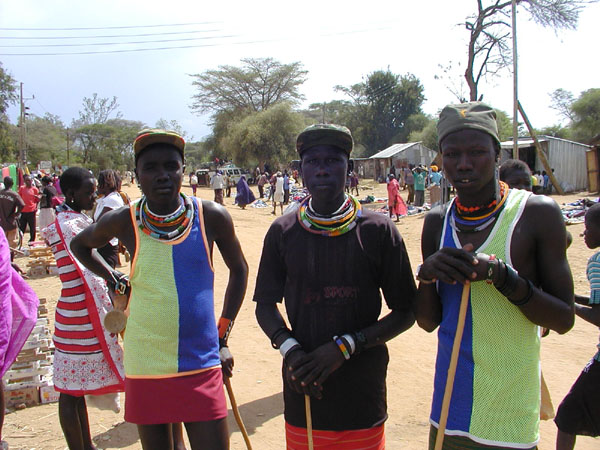
The other day a friend asked me to help a student studying missions. This student was writing a paper on how to work with animistic people. Since I worked with such a group for many years, the Pokot tribe of northwest Kenya, he sent me a series of questions to get my insight. One question was interesting.
“Can you describe the process of beginning to establish a relationship with someone for the sake of witnessing?”
I’m not sure why, but that question struck a defensive cord within me. “Why,” I wondered, “would anyone develop a relationship with someone just for the sake of witnessing about Christ?” Now that I’ve had time to think about it I guess I get the question, though I think it could have been crafted differently.
Most pastors and missionaries do seek avenues of developing networks of relationship, which lead to witness. Joining the Lions Club in the city, being a chaplain on the police force, starting a feeding program among the poor, teaching English, etc. These methods, and a host of other ways into the community, are not bad within themselves. Outsiders do need to build relationships, whether they are in the ministry or in business. The crucial question here is, does the means justify the end?
My answer to the student was that a person should establish a relationship with the Pokot, or any person, because it’s the natural thing to do, not merely an path for sharing the Gospel. As a follower of Christ I will share my faith, when given the opportunity, with anyone. But should I develop friendships for the express purpose of evangelism?
One my Face Book friends uses his “friendship” to advertise his business. Daily he posts something about his company in an attempt to drive traffic to his website. Occasionally I have used FB to do the same thing, but my friend uses it so much that I have put him in my “hide” box. I don’t want our relationship, even through the electronic social network, to be used for his sales agenda.
I think you get the point. Yes, there are legitimate ways in building a network of friends in a community. However, the best way to present Christ is to honestly make friends with people. It took me years to develop a network of relationships with the Pokot and I must admit, most of it was driven by how I could tell them about Jesus. Perhaps one reason the Pokot, and many other unreached people groups in the world, are still not reached is because they can “smell” our proselytizing agenda. So my advice on how to reach the unreached is simple – learn their language, learn their culture and worldview; develop genuine friendships within the community through everything from starting a school to being a cattle herder. If you do that well you will always have an opportunity to tell your friends the importance of Christ in your life.
Monday, April 19, 2010
The Hard Truth of Reality

The pessimist probably knew he would be dead soon even as someone was rolling him into a snowball. In spite of the grin on his face, he was unhappy the day he was formed.
Tuesday, April 13, 2010
Buckwheat Is Just O-Tay!

The first night for supper I was told we would be having buckwheat.
"Do you know what buckwheat is?" I was asked.
"Not really," I replied. My mind conjured up an image from my youth, but it didn't have anything to do with grains.
Ukrainian food is a bland compared to American food and almost tasteless to Indian standards. But I found that with plenty of salt, cabbage it's not bad. Not great, just O-Tay.

Tuesday, April 06, 2010
Act Like You Care

A friend of mine in New Delhi works with international corporations teaching cross-cultural studies. He asked me recently before one of his sessions, “What do Indians need to know about working with Americans?” My answer, “Tell them to ACT LIKE THEY CARE. Americans hate it when people have an ‘I could care less’ attitude. We are a ‘is right’ mentality. Customer service is a big deal for us, whether it is from people who live in another country or from those at our local store.”
My brother is a business consultant and works internationally. He has some great stories on this subject. He told me of a friend of his who walked into a bookstore in Russia and asked the owner if he could see the book on the top shelf. The owner asked, “Are you going to buy it?” The guy said, “I might, but I want to read the cover and table of contents first? The shop owner replied, “If you’re not going to buy it, I’m not going to climb up to get it down.”
Recently he was in Cyprus and he told the group he was working with that in America when he walks into a Wal-Mart store there is always a “greeter” at the door. He said if I need to know what aisle the toothpaste is on he can ask the greeter and that person will direct him to the area of the store he could purchase that item. He intentionally went to a store in their country and stood in one spot looking around, hoping someone would come up and ask if they could help. After fifteen minutes he gave up, not one person in the store acted like they cared whether he was being served or not. He told the company, “In your country you have people at the door to make sure the customer doesn’t take a bag inside or to make sure people don’t walk out without paying for a product, but you don’t have anyone who is there to help the customer.”
Acting like you care goes a long way in ministry and missions. Telling others about Christ is not just standing at the check-out counter ready to ring someone up for Jesus. Yet sometimes, I fear, that’s what our programs and methods are like. The church has its programs to draw people in and we visit “prospects,” but that doesn’t mean we care, it’s merely a means to sell our product, boost our attendance and increase our treasury. Acting like you really care means helping people with their problems even if they have no interest in hearing the Gospel. Acting like you care is visiting that drunk, old person in a nursing home, that single mom working long hours just to survive. These things may or may not help your ministerial bottom line, but it’s what Jesus calls, “Loving others as you love yourself."
Acting like you care is a big deal. Whether one is selling nuts and bolts, tomatoes or computers. One way to bring people back to your place of business is to ACT LIKE YOU CARE, even if you don’t. For the servant of Christ, acting like you care doesn’t cut it. People can usually see through false compassion. But the principle is the same; no one will ever be drawn to Christ if His disciples don’t show they genuinely care.
Wednesday, March 31, 2010
Romanians in India and MBI Report
 Discipling cross-cultural missionaries in Patna, India, one of the participants was a Romanian woman who has lived in the country several years. She met her husband, a Korean missionary there and married. The common language in the home is Hindi as she doesn't speak Korean and he doesn't speak Romanian. She told me she wished she had this training before coming to the field. I will be in Romania teaching in July.
Read more of our monthly report by clicking HERE.
Thursday, March 25, 2010
CAMEL Method Debate: Another Case of Missing the Point

While I appreciate and encourage healthy debate, punches and counter-punches in some disputes end up missing the point. As with most discussions, be it religion, politics, economics or global warming, there is a line drawn in the sand and you are either for it or against it; you are right and they are wrong and, like all good fights, there is a winner and a loser.
So, call me a good post-modernist if you will, but I see the strengths and weaknesses of both arguments. Caner is right that some Muslim evangelism is dishonest, not only to Scriptural principles but also to Muslims. When a Christian, in an attempt to blend into the Muslim community so much that he/she hides their identity as a follower of Isa (Arabic for Jesus), then one reasonably can ask the question what’s the point of even working with Muslims? Rankin is correct that the extraction theory, i.e. that followers of Isa should renounce all that is Muslim and indentify with the new community of the church, is a non-starter in bringing Muslims to faith in Christ. Here is my problem with both Caner and Rankin’s position.
To Caner, dialogue is not compromise. If I am sitting in a village in North Africa that is predominately Muslim I would be foolish not to dialogue with my neighbors, using every contextual tool I can in the process of learning and teaching. This would include using the Koran, referring to God as Allah and agreeing that Isa was a prophet. All truth is God’s truth no matter what form it takes. My witness of Isa can and will be enhanced if I enter into discussion from the viewpoint of my hearers. Of course there is a point when every follower of Christ must make his or her faith definitive. When that takes place and what form it will take is not for me to dictate. If in the process of dialogue, which may take years, I am telling the story of biblical converts, then I am content to let new belivers come to their own conclusions as they are led by the Holy Spirit.
To Rankin, God’s work is not defined by methods or “best practices.” The IMB, and unfortunately most missionaries around the world, are enamored with programs. Chronological story telling, the Jesus Film, BAM (business as mission), EE (evangelism explosion), starting people movements and the CAMEL method are all great tools if they are recognized as such, a tool, not a silver bullet for evangelism. I used the chronological method among the tribal’s of Kenya before it came off the Broadman Press. How? By living with culture and understanding how they viewed their world. Building relationships in a community is not through starting a business. Contextualization is not manipulating dialogue. Good missiology is learning the questions before giving the methodological answer.
Saturday, March 20, 2010
Davy Crockett and Missions
When I heard that Fess Parker died yesterday, my mind went back to a time that I vaguely remember, yet it some ways, a period that was maybe more real than today.
It was probably around 1955 when we got our first TV (yes, I am indeed that old) and I have vivid memories of watching Davy Crockett on the black and white screen in the den of our house in Gardena, California. Those were the days of frontier heroes like, John Wayne, Gunsmoke (James Arness), The Rifleman and Have Gun Will Travel. It was the transition time between the singing cowboys of Roy Rogers and Gene Autry. It’s amazing that after 55 years I can still remember the opening lines of the ballad of Davy Crockett . It was a time when good and evil was clearly distinguished, justice didn’t have the ACLU, where hero’s earned their place in history and highest form of being an American was honesty and hard work.
Well, no sense in pining away for the old days, but gee I miss those days when the goal was clear and the only obstacle was not measured in dollars but in one’s commitment to the task. Though it’s been over fifty years Crocketts advice still rings true - “Be sure you’re right – then go ahead.”
Sunday, March 14, 2010
Idolatry of Missions

I recently read in a Biola (my alma mater) magazine a confession of a missionary. His testimony was that he had made missions an idol. The idea of being a missionary was so all consuming that it affected his relationship with his wife. His spouse was not opposed to going to the mission field, but she saw their role as more of senders rather than goers. The conflict between them intensified until he came to grips with this one question: What is the core issue of life? Christ or being a missionary? It was at that point that he came to terms that missions had become, for him, an idol.
How do I know this? Because it happened to me. When I came off the field I was riddled with guilt. How could I possibly serve Christ to my fullest teaching missionaries in the U.S.? Sharing my frustration with Lloyd Kwast (former missionary to Cameroon and professor of missions at Biola) Lloyd asked me point blank, “Richard, do you really think God loves you more as a missionary in Kenya?” Like the guy who nearly tore up his family in pursuit of missions, I had made missions an idol.
Obviously I believe that being a career missionary is a noble profession. Having been one for 35 years I can testify that it has been a rewarding life; I have no regrets and wish more people would experience the sheer joy of living and working overseas for Christ. However, I have never believed that being a missionary is the highest calling a child of God can have. I maintain that the most important thing for any follower of Christ is to love the Lord thy God with all thy heart, soul and mind. Fulfilling that, the greatest of all commands according to Jesus (Mark 12:28-30), is that thing which all Christians should desire whether they are a truck driver, farmer, secretary, housewife, businessman or missionary.
Being a witness for Christ is not a profession; it’s a natural outflow of faith to a person who lived 2,000 years ago. When the task becomes more important than the person then we have changed the dynamics of our discipleship, from being a missionary to a mercenary; from making a calling an idol.
Sunday, March 07, 2010
Dirt

“The one thing visitors always comment about,” my friend in Delhi said to me recently, “ is how dirty India is. I know there is a lot of trash and it’s not like America or Europe, but I’m amazed how that seems to be the only thing people from abroad talk about.”
A few days earlier in my class we discussed the issue of purity and profane from a cultural and biblical perspective. In the Old Testament the book of Leviticus is a list of clean and unclean things, ranging from food, bodily fluids and even people. In the New Testament Jesus rebuked the religious fundamentalist on their obsession with ritual purity. While Jews, Muslims and Hindus abstain from pork as unclean, Americans believe a good ham on Thanksgiving or Christmas should be on every holiday table. Americans wouldn’t think of eating a dog, but in the Orient it’s a delicacy. Horse meat is still acceptable in France and, of course, the Chinese will eat just about anything.
Anthropologist Mary Douglas defines “unclean” as anything out of place. Dirt in the yard is okay, but dirt in the house is considered unclean. Hair, which we wash and shampoo to make it shiny, is a matter of personal beautification. Hair found in food can be so repulsive that some people get physically ill at the thought. Dirt is more about position than it is hygiene.
While Americans believe that cleanliness is next to godliness, culture determines what is clean or unclean. College kids visiting India may be horrified with the filth they see on the streets, but these same kids, with the grunge look, walk around in dirty clothes and unkept and mangy hair.
It’s true, in poor countries there is a lot of trash, open sewers and unsanitary habits, like urinating in public. For most people, though they may wish they lived in a different environment, it’s a way of life. Why? Because dirt is placed where it should be, outside. Inside their own dwellings it is well maintained and clean.
Jesus told His accusers that while they focused on outward dirt they were oblivious to the greater issue, uncleanliness of the heart. I’m all for clean food, water and the environment, but rather being overwhelmed with the outward issue of dirt maybe we should deal with those unclean toxics of the heart and not so much on the things we see on the streets.
Monday, March 01, 2010
Perception of Good

One of the great challenges of hermeneutics is understanding context. This past two weeks I have been trying to bridge the gap between the traditional critical and historical approach to interpretation of scripture by using cultural anthropology as a model for contextual analysis. What does anthropology have to say about “honor and shame,” “purity and impurity,” “kinship and marriage,” and “limited good,” as it relates to understanding the first century church?
Missiologists have never advocated that the social sciences be THE model for interpretation of context. However, I am amazed how many theologians discount the role or even the validity in using cultural anthropology as a tool for scriptural understanding.
Anthropologist George Foster, in 1965, stated that in peasant societies (which one can clearly see in first century Palestine) there was an image of limited good. By that he means the access to goods, honor and resources was not abundant but indeed restricted. A person and/or family either had or did not have access to good based on kinship. Land owners, craftsman, tenant farmers for the most part were ascribed status within society. The only way good was achieved beyond cultural ascription was through deception and abuse of power. Vassar kings, like Herod, were despised by the common folk as his allegiance was to Rome and not the people he was given charge to rule. Matthew and Zacchaeus were despised “sinners” as their profession of tax collection was often a means to exploit others for their benefit. Limited good is a sum zero game. For someone to grow rich someone else must suffer loss. The rich get richer as the poor get poorer (a classic tension between capitalism and socialism as it plays out in today’s world).
Fast forward to the story of the landowner giving talents (investment capital) to three servants. Two servants make a handsome ROI (return on investment). The third steward is ridiculed and ostracized because he was not willing to be a Zacchaeus. You would think that the interpretation of this story is that the hero is not those who gain ROI in a limited good society, but the one who was willing to face the wrath of a harsh master rather than turn against his fellow countrymen. But that is not how the average evangelical theologian interprets this parable. Through the lens of unlimited good, capitalism and profit margins, the hero is the one who uses his talents to gain more talents. “Well done, good and faithful servant, you have been faithful (exploiting) with little to gain more. Enter into the joy of the Lord.” (Okay, I am going over the top in my interpretation, but I do so for effect and to make my case). The point being is that to be consistent in interpretation of scripture all tools or models can be helpful, including cultural anthropology. Especially as it relates to first century Palestine, today’s model of unlimited good does not fit, though we continually try to make the case through the lens of economic expansion.
Distorted hermeneutics comes into play when we try to make our interpretations fit into our culturally biased analysis. On this issue Lingenfelter writes, “One of the distortions that we as human beings bring to social relationships is that of making our familiar structure the only structure that God can use to accomplish his purpose. We distort the diversity of God's creation and reduce the structures for human life to those that are familiar to us. By denying the validity of other structures, we force people to submit to our standards and structures of relationship in order to accomplish the work and purpose of God (LEADING Cross-Culturally: Covenant Relationship for Effective Christian Leadership. Baker Academic: 64)
The parable of Luke 19 is still up for debate. Was Jesus teaching his audience to be counter-cultural, ahead of his time in seeing the world with unlimited resources? Or, was he making a strong case against greed in a limited good society? For those who think anthropology has nothing valid to contribute to the study of scripture the third steward is an example of squandering God’s talents he has given us. That lazy servant should indeed be cast into outer darkness, alongside those who use social science as tool for interpretation of scripture.
Tuesday, February 16, 2010
Culture and Negotiations

How much do you know about culture? If you were “negotiating” in a particular cultural environment, would you understand the rules by which that culture plays the game of life? Here are some examples, answer true or false.
The Chinese won't spend much time gathering and exchanging information since they are often eager to get started with the bargaining exchange.
Negotiators in Israel often use silence as a pressure tactic to obtain further concessions.
In the Netherlands, a person sucking their thumb is signaling that he or she does not believe you.
In Japan, prices rarely move by more than 10-15% from initial offer to final agreement.
For more questions on negotiation and cultures go to:
http://www.globalnegotiationresources.com/resources/quiz/
How did you do? Share your results.

